Tuesday, October 1, 2013

PROFILES IS OUT.


The Fall/Winter issue of Profiles is out! Pick your complimentary copy up at the Rucker MD Plastic Surgery Clinic, the Enza Medispa or grab one of these upcoming newspapers:
  • Leader Telegram: Saturday, October 5th.
  • Pioneer Press: Wednesday, October 9th.
This issue's topics include:
  • Functional vs. Cosmetic Rhinoplasty
  • 5 Facelift Factors to Consider.
  • Dr. Rucker in Arizona Sports and Lifestyle Magazine.
  • Your 5 Minute "Anywhere Workout" by Lori Heck.
  • Do you need a Facelift?
For your free copy, email us at info@ruckermd.com or call the office at 715.833.2116. Our staff is always happy to assist!

Monday, September 30, 2013

The Top 5 Nose Complaints. Sound Familiar?


While we can often disguise protruding ears with different hairstyles and soften the appearance of our eyes with makeup, the nose is the most noticeable facial feature and is more difficult to hide or disguise. In the 500+ Rhinoplasty procedures that I have performed, I have employed a highly focused individualized approach which avoids the dreaded “operated on” or “done” appearance.

FUNCTIONAL nasal problems usually arise from an injury and result in a disfigurement of the nasal shape with complaints of obstructed nasal breathing.
     Most functional Rhinoplasty candidates  have sustained an injury to the nose that has resulted in a possible nasal fracture and/or displacement of the internal partition of the nose, which separates one nostril from the other. The most common concerns - difficultly breathing through the nose and severe headaches.
     The nose may appear disfigured, often identified by a hump at the mid-portion of the bridge. An internal examination may confirm that there is, in fact, a deviation of the nasal partition resulting in a partial blockage of nasal airflow. We then would develop an operative plan to restore the displaced nasal structures to their original position, and to rearrange the displaced nasal partition in an effort to restore normal nasal airflow. The reconstruction of a functional nasal problem is usually covered by one’s insurance.

COSMETIC nasal problems include the above complaints of “my nose is too large”, “I hate my hump” or “the tip is too large”. These are characterized as cosmetic because their improvements do not affect the function of the nose and the ultimate goal is to produce a better appearance of the nose. I refer to this type as an “aesthetic” Rhinoplasty. It is important to understand that the shape of the nose is dictated by the bone and cartilage framework beneath the skin.  It is therefore the goal of the cosmetic nasal surgeon to reshape the framework beneath the skin to reduce the size and shape of the nose, without producing a result that looks “done”.
     In the case of an aesthetic Rhinoplasty, I feel the most important aspect of the initial consultation is to determine whether the results of the procedure can realistically meet the patient’s expectations.  Difficulties can arise when a patient states, “I want my nose to look exactly like this,” and presents a photo of a celebrity.  This type of result is often not realistic, firstly, due to other facial features contributing to the nasal appearance, and secondly, because the nasal framework may not allow a specific result. However, certain characteristics of someone else’s nose may be incorporated into each individualized Rhinoplasty. A detailed examination of the candidate is performed and an operative plan to address the patient’s concerns is formulated. Because this is a purely cosmetic procedure, it is not covered by insurance.

The Nasal (Rhinoplasty) Procedure:  Both functional and cosmetic procedures are done under a general anesthetic and on an outpatient basis.  Each procedure takes about two hours to perform. Most patients rate the pain on a scale of 1 to 10 as a 4 to 6.  There is a dressing in place for 6 to 7 days, and upon its removal the patient’s result is noted with a moderate amount of swelling.  Patients typically feel comfortable being in public after Rhinoplasty in seven to eight days.

To set up a consultation, call Dr. Rucker’s office at 715.833.2116. Our staff is always happy to assist!


Wednesday, September 11, 2013

MINNESOTA BREAST CANCER AWARENESS ASSOCIATION ANNUAL CONFERENCE


Dr. Joseph Rucker, has been selected to be a keynote speaker at the 12th Annual BCAA Education Conference in Minneapolis, MN on October 12th. 

He will be speaking on "Staying Abreast: Innovations in Plastic Surgery".

Tickets are available for purchase at www.bcaamn.org.

Thursday, June 13, 2013

Monday, June 10, 2013

The Future of Breast Augmentation.


Silicone or saline? That is the question that many women on the market for a breast augmentation face. When weighing the options, there have always been strong arguments for both sides. Thanks to new technology, the future of breast augmentation is here with a new implant that has the best of both worlds.

Up until five years ago, the salt water filled implant (saline) has been the preferred implant. The standard silicone implant has since returned to favor, but there has always been that lingering doubt of what happens if it leaks. 


Saline Implant Benefits:
  • Non-toxic in the event of leakage since it is filled with salt water.
  • Size can be varied by merely adding more fluid to enlarge it.
Saline Implant Drawbacks:
  • Does not feel natural.
  • Tends to reveal itself more by producing ridges on the breast.
  • Higher chance of leakage.
Over the past five years, many of my patients have chosen the silicone-filled implant because it does feel much more natural, and it tends to not show the ridges beneath the skin that the saline implant does. Nonetheless, it still causes some concerns if there was leakage, and the silicone was to leak into the breast tissue.

Currently, I feel the saline-filled implant and the standard silicone gel filled implants will be obsolete within the next two years. This is due to the current availability of the revolutionary high tension, gel implant – AKA the “Gummy Bear” implant. The term is coined from the fact that when cut in half, the breast implants are able to retain their shape with no leakage, similar to the popular gummy bear candies.

The benefits of the “Gummy Bear” implant are so pronounced that it has become my implant of choice.


"Gummy Bear" Implant BENEFITS: 
• Smaller chance of a leakage of gel into the body if a rupture is to occur.
• Natural feel, similar to the gel-filled implant.
• Multiple shapes and sizes offered.
• Cost is very comparable to the standard gel-filled implant.
• Some studies suggest that there may be less of a chance of scarring around the Sientra “Gummy Bear” implant.


With these suggestions and information in mind, it is important to remember that a consult with your plastic surgeon is highly recommended to determine your personalized needs. For more information or to set up an appointment, please call 715.833.1068 and speak to our patient coordinator.

Wednesday, June 5, 2013

It's here! PROFILES Summer 2013!

Check out the latest issue of PROFILES magazine to read up on:
  • The Future of Breast Augmentation by Joseph Rucker, MD, FACS
  • Benefits of Stem Cells in your Skin Care Regimen
  • Menopause & You by Donna Schoenfelder, MD
  • Help! I have ACNE SCARRING
  • Group Workouts You Will LOVE by Lori Heck, ASPIRE Personal Training
  • Feed Your Skin! by Tammy Schofield, MS, RD
  • The Enza Medispa summer specials!

Friday, May 3, 2013

Mastectomy and Immediate Single-Staged Skin-Sparing Breast Reconstruction

A Breast Cancer diagnosis is devastating and the idea of a mastectomy is often just as difficult to accept. While your primary goal is to rid your body of cancer, it can be hard to imagine ever getting back to feeling “whole” again. Part of a complete recovery is restoring confidence in how you look and feel.
Dr. Joseph Rucker performs the new skin-sparing, single-stage mastectomy and immediate reconstruction which preserves, in some cases, the nipple and areola as well as the breast skin. 

The benefits of this technique are:
  • One surgical procedure for both the mastectomy and reconstruction.
  • One recovery.
  • Patient's skin envelope is preserved.
  • Usually only one overnight hospital stay required.
  • No increased risk of recurrence.
  • Better cosmetic result after reconstruction.
The Procedure: On the surface, your natural breasts are preserved. Inside, your tissue is completely replaced with an implant. This state of the art procedure involves the cooperation of a cancer surgeon and Dr. Rucker acting as a team, along with your oncologist. 

Until now, mastectomies involved flaps, expanders, tattoos and scars. Skin and nipple-sparing mastectomy offers an option that is less severe and more cosmetic. By retaining the shell of your natural breasts and using an implant, the results often resemble a breast augmentation rather than a reconstruction.

Insurance Coverage: Single or double mastectomy? A federal law was passed in 1998 requiring all health insurance companies to cover reconstruction of the breast on which mastectomy has been performed. Additionally, it covers surgery and reconstruction of the other breast to produce a symmetrical appearance.  Because of this, women with a higher risk of developing breast cancer, and who formerly might have considered a single mastectomy now elect to have both breasts removed and reconstructed.

Risk of Recurrence: Skin-sparing mastectomy has been advocated as an oncologically safe approach for the management of patients with early-stage breast cancer that minimizes deformity and improves cosmesis through preservation of the skin envelope of the breast. Extensive research has been done regarding this procedure when compared with mastectomies that remove all the tissue, skin and nipples. The result? The new skin and nipple-sparing mastectomy in no way contributes to recurrence. In addition, careful review of scientific research over 20 years found no proven link between breast implants and auto immune or other systemic diseases, nor do they inhibit future cancer detection.

Candidates for Procedure: Many, but not all, patients are candidates for a skin-sparing mastectomy. Your choices may be limited by your pathology or prior surgeries. However, this new option has made women with the BRAC gene and those at high risk for breast cancer consider a skin and nipple-sparing mastectomy prophylactically - removing the tissue as a potential target. Others considering lumpectomy, which can be disfiguring, can now confidently opt for removal of all tissue while preserving and enhancing their natural breasts. These patients leave the hospital not only with their shape and contour intact, but the gift of peace of mind, knowing that all of the breast tissue has been removed.

Philosophy: Dr. Joseph Rucker, a board certified plastic surgeon with advanced training in breast reconstruction techniques, approaches reconstruction no differently than an elective cosmetic procedure. His keen aesthetic sense makes his goal to leave every woman looking even better than before their unfortunate diagnosis. Working closely with a cancer surgeon and your oncologist, Dr. Rucker will help determine if you are a candidate, considering your individual treatment plan and overall health.  
To view a short video on this subject go to: http://www.youtube.com/watch?v=zUXv2RWny6A.

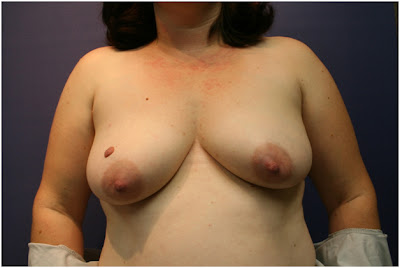
40 year old female with advanced premalignant breast disease and also with a strong family history for Breast Cancer. She requested bilateral mastectomies and immediate single-stage bilateral breast reconstruction.
1 month after bilateral skin and nipple-sparing mastectomies and immediate reconstruction.